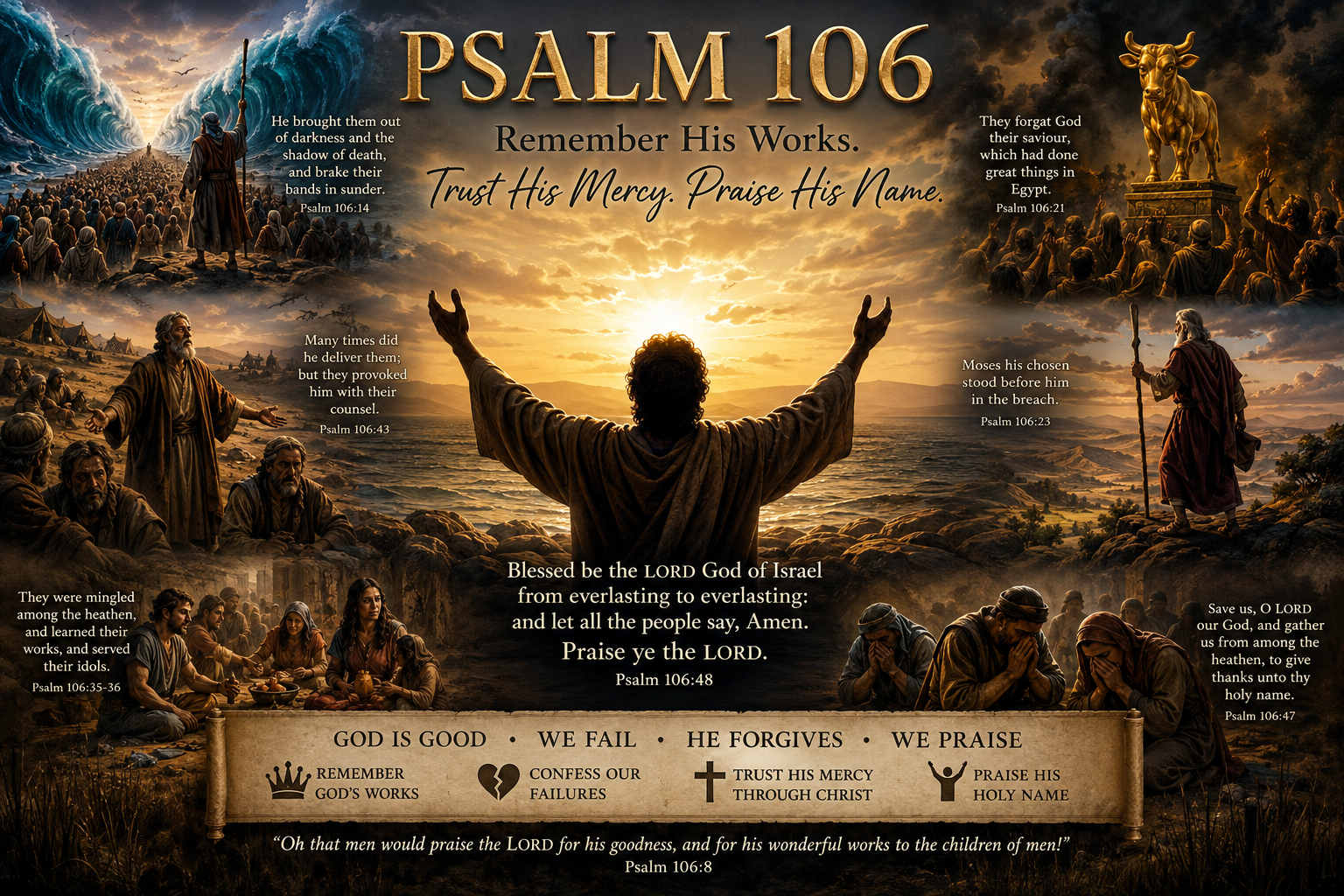

Psalm 106 is a powerful psalm about God’s goodness and faithfulness contrasted with the repeated failure of His people. It looks back over Israel’s history and shows a pattern: God blesses → the people forget → they rebel → trouble comes → they cry to God → God shows mercy again.
1. Remember the goodness of God — verses 1–5
It begins:
“Praise ye the LORD. O give thanks unto the LORD; for he is good: for his mercy endureth for ever.” — Psalm 106:1 (KJV)
Before speaking about Israel’s sins, the Psalmist establishes something important: God is good. The failures described later cannot be blamed upon God. His mercy continues even when His people wander.
2. Israel forgot what God had done — verses 6–12
The Psalmist confesses:
“We have sinned with our fathers, we have committed iniquity, we have done wickedly.” — verse 6
Israel had witnessed God’s mighty works in Egypt, yet they quickly forgot His mercy. At the Red Sea they became afraid and doubted Him.
Nevertheless, God rescued them “for his name’s sake” (verse 8). He divided the Red Sea, brought His people safely through, and destroyed their enemies.
There is an important lesson here: yesterday’s miracle does not automatically produce today’s faith. We need continually to remember what God has done.
3. They wanted God’s gifts more than God — verses 13–15
One of the saddest statements is:
“They soon forgat his works; they waited not for his counsel.”
Then verse 15 says:
“And he gave them their request; but sent leanness into their soul.”
That is a solemn warning. Sometimes getting what we desperately want is not the same thing as receiving God’s best.
A person can have material abundance and yet suffer spiritual leanness. We should therefore seek God’s will rather than simply asking Him to approve our own desires.
4. Rebellion entered the camp — verses 16–23
The Psalm remembers the rebellion of Dathan and Abiram and then Israel’s terrible sin with the golden calf.
They exchanged the glory of God for an idol:
“Thus they changed their glory into the similitude of an ox that eateth grass.” — verses 19–20
Then comes the underlying problem:
“They forgat God their saviour.” — verse 21
That phrase could almost summarize the whole Psalm.
Their problem began with forgetfulness of God, and forgetfulness eventually produced disobedience.
5. Moses stood in the gap — verse 23
This is one of the great verses of Psalm 106:
“Therefore he said that he would destroy them, had not Moses his chosen stood before him in the breach…”
Moses interceded for the people.
There is a wonderful picture here of intercessory prayer—someone standing before God and pleading for others.
For Christians, it also points us toward Christ, our great Intercessor. Moses stood in the breach for Israel; Jesus Christ is the perfect Mediator between God and man.
6. They despised God’s provision — verses 24–33
Israel even despised the Promised Land:
“Yea, they despised the pleasant land, they believed not his word.” — verse 24
Notice the connection: they did not believe God’s Word, therefore they did not obey God’s voice.
Their unbelief eventually affected Moses too. At Meribah the people’s rebellion provoked him, and Moses spoke unwisely.
This shows that persistent rebellion can affect not only the rebellious person but also those around them.
7. Compromise led them into idolatry — verses 34–39
When Israel entered Canaan, they failed to obey God’s commands concerning the surrounding nations. Instead:
“But were mingled among the heathen, and learned their works.” — verse 35
That is a serious spiritual principle.
They first mingled, then learned, then served their idols.
Compromise rarely announces where it will eventually lead. Small departures from God’s Word can become much larger departures over time.
8. Yet God remembered His covenant — verses 40–46
Because of their rebellion, God allowed Israel’s enemies to oppress them. Yet this astonishing statement follows:
“Many times did he deliver them; but they provoked him with their counsel…” — verse 43
Many times.
That tells us something wonderful about God’s mercy.
Israel failed repeatedly, yet when they cried unto Him, God heard them. Verse 45 says:
“And he remembered for them his covenant, and repented according to the multitude of his mercies.”
Their hope was not that they were faithful enough.
Their hope was that God remained merciful and faithful to His covenant.
9. The Psalm finishes with a prayer for revival — verses 47–48
After remembering all these failures, the Psalmist cries:
“Save us, O LORD our God, and gather us from among the heathen, to give thanks unto thy holy name, and to triumph in thy praise.”
Psalm 106 therefore isn’t merely history. It is a warning and a prayer.
The message for the Church today is very relevant:
Do not forget God. Do not exchange His glory for the idols of the age. Do not allow compromise to replace obedience. Do not seek His blessings while neglecting Him. Remember His works, believe His Word, obey His voice, and seek Him for mercy and revival.
And perhaps the great encouragement of Psalm 106 is this: even after describing generations of failure, the Psalm still ends with praise.
“Blessed be the LORD God of Israel from everlasting to everlasting: and let all the people say, Amen. Praise ye the LORD.”
Our failures may be many, but God’s mercy is greater.
GOD IS A GOOD GOD
GOD KNOWS, GOD LOVES, GOD CARES
Written for Georges Web Ministries.com
Georges WebMinistries. Com
Georges Bible Ministries
George Poem .com
Gi7Ministries.com
12th August 2016