
Weeping may endure for a night Psalm 30 Explained
Psalm 30 — A Song of Deliverance and Restoration
Background of Psalm 30
Psalm 30 is a psalm of thanksgiving written by King David.
It is a song about being lifted up by God after a time of suffering, fear, sickness, and sorrow. David remembers how close he came to destruction, yet the Lord showed mercy and restored him.
The psalm teaches us that:
- Trouble does not last forever.
- God hears sincere prayer.
- Pride can make a person careless.
- The Lord can turn sorrow into joy.
Verse-by-Verse Explanation
“I will extol thee, O Lord; for thou hast lifted me up…” (Verse 1)
David begins by praising God publicly.
He says God “lifted” him up, like someone pulled from a deep pit or rescued from drowning.
David knew:
- it was not his own strength that saved him,
- it was the mercy of God.
Sometimes people only cry to God in trouble, but David also thanked God after the answer came.
“O Lord my God, I cried unto thee, and thou hast healed me.” (Verse 2)
David had cried out in desperation.
This healing may have been:
- physical healing,
- emotional healing,
- spiritual restoration,
- or rescue from enemies.
The important lesson is this:
God listens when His people cry sincerely from the heart.
“Thou hast brought up my soul from the grave…” (Verse 3)
David felt close to death.
The word “grave” speaks of destruction, hopelessness, or the place of the dead.
Yet God brought him back.
Many believers understand this feeling:
- depression,
- fear,
- exhaustion,
- deep grief,
- spiritual battles.
But God is able to restore what looked finished.
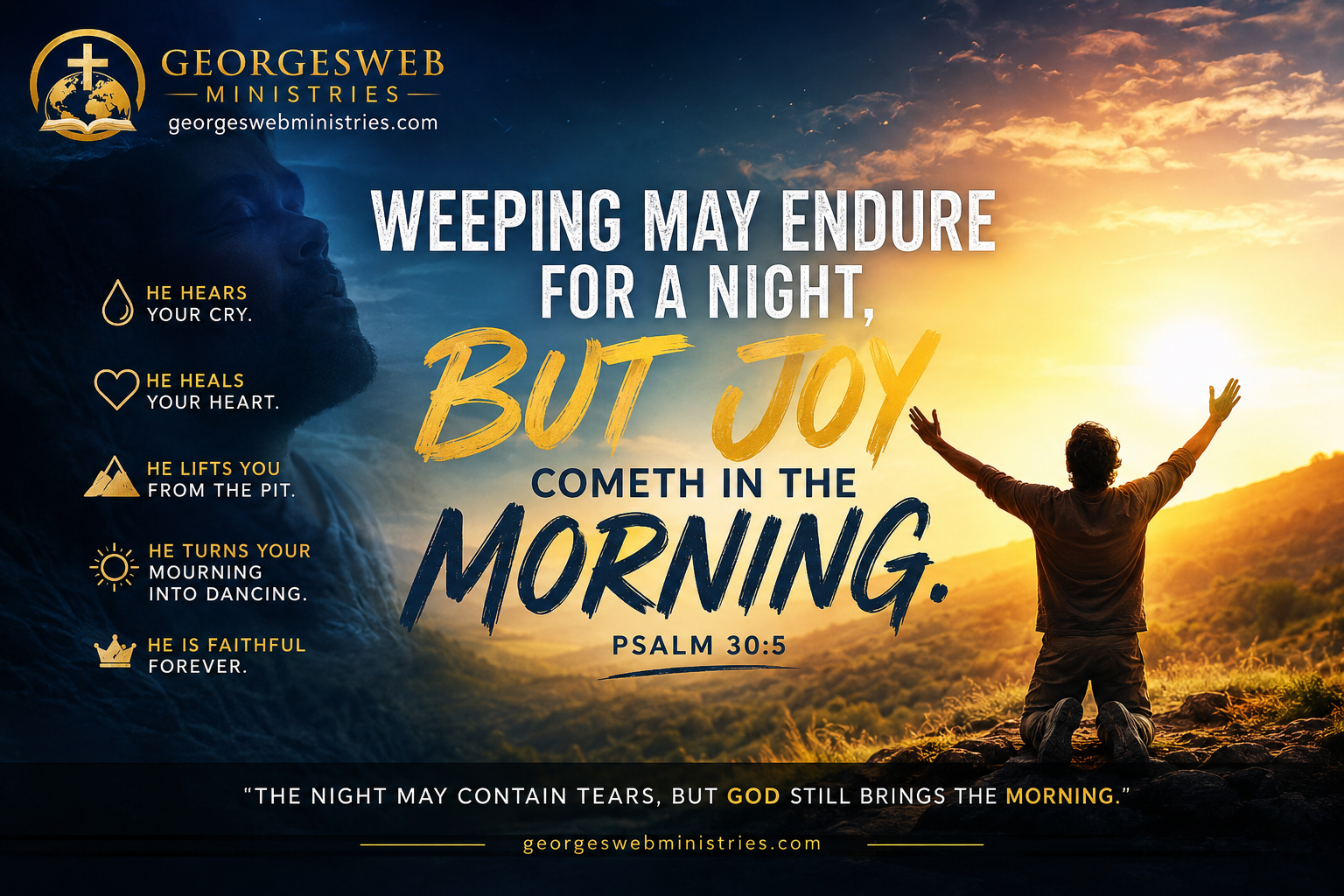
“Weeping may endure for a night, but joy cometh in the morning.” (Verse 5)
This is one of the most famous verses in the Psalms.
\text{Weeping for a night} \rightarrow \text{Joy in the morning}
David is saying:
- pain has a season,
- sorrow has a limit,
- but God can bring a new morning.
Night represents:
- trials,
- confusion,
- loneliness,
- unanswered prayers.
Morning represents:
- hope,
- renewal,
- peace,
- and God’s intervention.
The night may feel long, but it does not last forever.
“In my prosperity I said, I shall never be moved.” (Verse 6)
David admits something honest here:
when life was going well, he became too confident.
Sometimes blessing can make people forget how much they need God.
David learned:
- strength can disappear quickly,
- health can fail,
- situations can change overnight.
Only God is unshakable.
“Thou didst hide thy face, and I was troubled.” (Verse 7)
When God’s presence felt distant, David became afraid.
This does not mean God truly abandoned him.
It means David felt the heaviness of spiritual silence.
Many believers experience moments where:
- prayers seem unanswered,
- heaven feels quiet,
- faith is tested.
But silence is not abandonment.
“What profit is there in my blood, when I go down to the pit?” (Verses 8–9)
David pleads for mercy.
He is saying:
“Lord, spare me so I may still praise You.”
This reveals David’s heart:
he wanted his life to glorify God.
“Thou hast turned for me my mourning into dancing…” (Verse 11)
This is the great turning point of the psalm.
God changed:
- mourning into dancing,
- sackcloth into joy,
- despair into praise.
“Sackcloth” was clothing worn in grief and repentance.
David is saying:
“The God who allowed the sorrow also brought restoration.”
Main Lessons of Psalm 30
1. God Can Lift a Person Out of Deep Trouble
No pit is too deep for the Lord.
2. Prayer Matters
David cried unto God — and God answered.
3. Good Times Can Lead to Pride
We must stay dependent on God even in success.
4. Sorrow Is Not Permanent
The darkest night still ends with morning.
5. God Desires Praise After Deliverance
David did not hide God’s goodness — he testified openly.
Spiritual Meaning Today
Psalm 30 speaks to:
- the grieving,
- the sick,
- the discouraged,
- the fearful,
- and those recovering from failure or hardship.
It reminds believers that God is able to:
- restore,
- heal,
- forgive,
- strengthen,
- and renew joy again.
Even when life feels broken, the Lord can still bring a new song out of sorrow.
GOD IS A GOOD GOD
GOD KNOWS GOD LOVES GOD CARES
WRITTEN FOR GEORGES WEB MINISTRIES
7th May April 2026