
Your piece already carries a strong emotional weight and thoughtful message. I’ve refined the flow, tightened some of the language, and made it more polished and literary while keeping your heart and meaning intact.
The Quiet Child
A Story of Unnoticed Struggles and Lifelong Learning
Introduction: A Silent Beginning
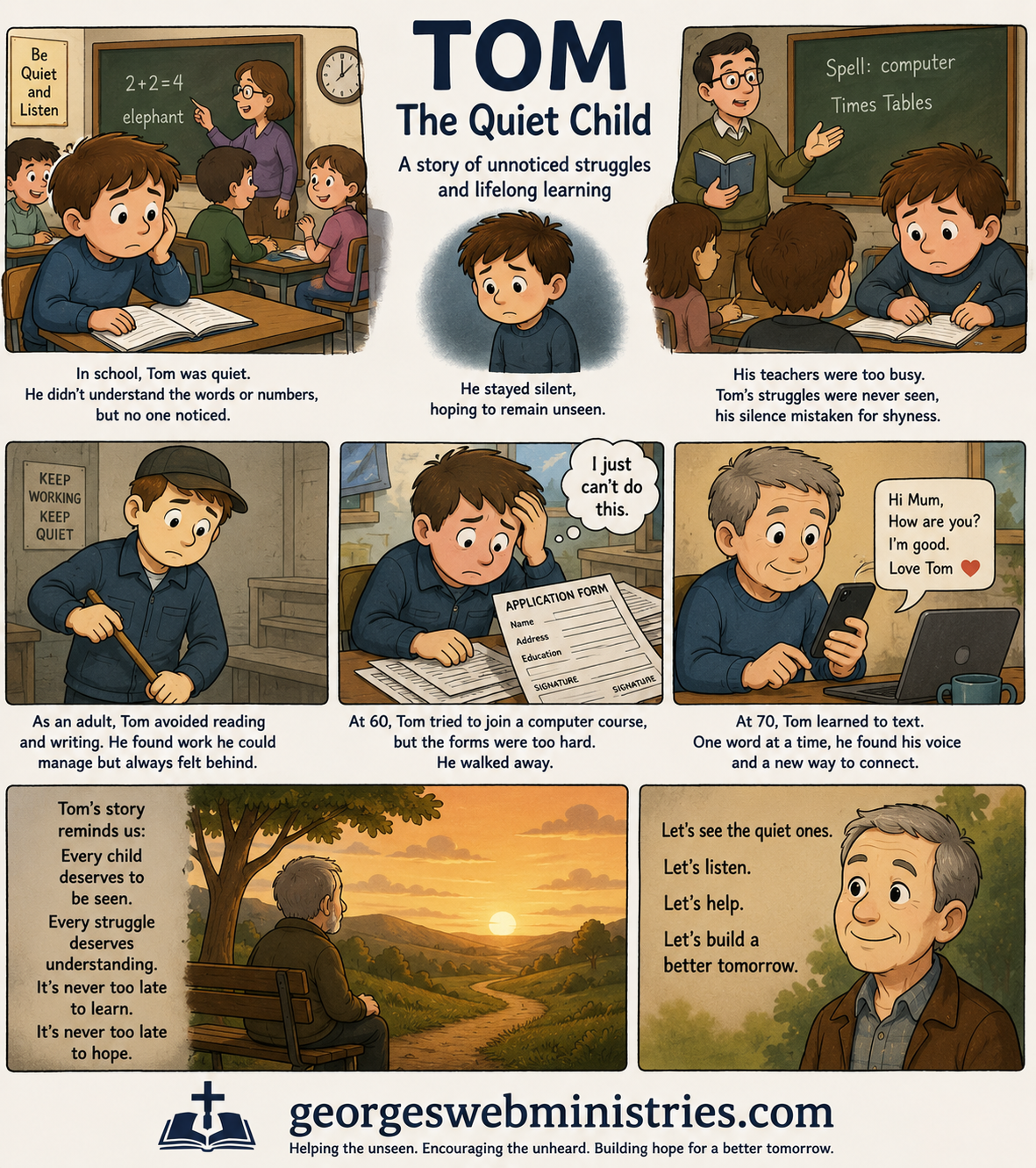
In a small town, nestled between green fields and grey skies, lived a boy named Tom. From the very beginning, Tom’s world was filled with words he could not grasp and numbers that slipped through his mind like water through open hands. School promised opportunity and learning, yet for Tom it quickly became a place where silence felt safer than failure.
No one noticed the quiet confusion behind his eyes as classmates recited times tables and spelt out the names of distant countries. Tom simply listened. He learned early that if he said little enough, perhaps he would remain unseen.
School Experience: Lost in the Crowd
Tom’s teachers, burdened with crowded classrooms and endless responsibilities, rarely looked closely enough to notice his struggle. Lessons rolled by like distant trains — heard, but never reached. When children were asked to read aloud or solve sums at the board, Tom shrank lower into his seat, praying not to be chosen.
Most times, he was overlooked.
His difficulties were never properly assessed. His silence was mistaken for shyness, his stillness for understanding. The teachers spoke to the classroom, but not always to the children within it. Tom survived school not through learning, but through hiding — a living reflection of the proverb:
“Even a fool is thought wise if he keeps silent.”
As the years passed, Tom watched others move ahead while he remained standing still. He could not count far without stumbling, nor confidently spell words like elephant or computer. Even his memory seemed fragile, like a radio fading in and out of signal. Yet still, no one truly saw him.
Adulthood: Carrying the Weight
Adult life brought its own quiet burdens.
Tom found work through determination and practical skill, carefully avoiding anything involving paperwork, forms, or written instructions. Whenever reading or writing became unavoidable, he covered his difficulties with excuses — poor eyesight, tiredness, a shaky hand. Most people accepted his explanations without question.
The world assumed every child left school equipped for life.
Tom’s spirit was never destroyed, but it was deeply bruised. He listened more than he spoke and learned to survive through observation. At times, he tried to teach himself. He opened books in libraries, watched others use computers, and attempted to follow along. But the old confusion always returned, and quietly, he would close the book once more.
Later Life: A Hopeful Attempt
At sixty years old, Tom decided to enrol in a computer course. He longed to connect with the modern world — to finally open doors that had always seemed closed to him.
But before the course even began, there were forms to complete.
Lines upon lines of questions and words he struggled to understand. Even spelling the word computer felt overwhelming. Embarrassed and defeated, Tom left before the first lesson started.
Yet something within him refused to surrender completely.
By the age of seventy, through patience, persistence, and sheer courage, Tom finally learned how to send text messages. It was slow work. Every word took effort. But with each message sent, he felt a quiet sense of victory.
For the first time in his life, communication no longer seemed entirely beyond his reach.
Reflection: Is the System Broken?
Tom’s story raises uncomfortable questions.
How could someone spend years in education and still leave unable to confidently read, spell, or count? How many others have slipped silently through the cracks — hidden behind quietness, mistaken for capable simply because they caused no trouble?
Was it the fault of overwhelmed teachers, overcrowded classrooms, or a system that sometimes values routine more than understanding?
Tom’s story is not his alone. It is a gentle warning and a call for reflection. Education is meant to be a ladder that lifts people upward, yet for some it becomes a wall they spend a lifetime trying to climb.
His journey reminds us that learning does not end with age, and hope does not entirely disappear. But it also reminds us of the importance of noticing the quiet ones — those who sit silently at the back, hiding confusion behind stillness.
Perhaps the greatest tragedy is not that Tom struggled.
It is that almost no one noticed.
GOD IS A GOOD GOD
GOD KNOWS GOD LOVES GOD CARES
Written for georgeswebministries
28th May 2026