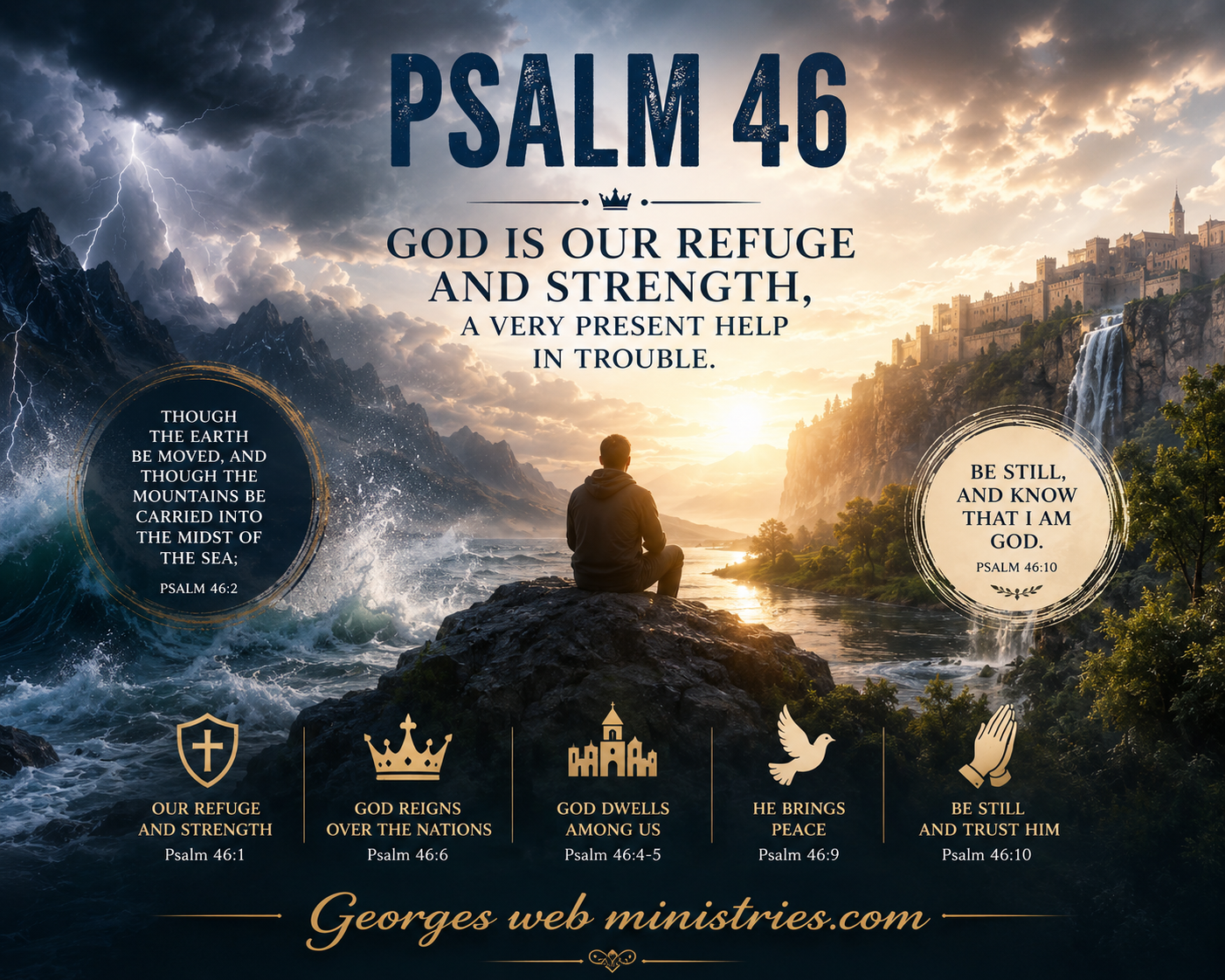

Explaining -Psalm Chapter 46
Book of Psalms Psalm 46 is a song of confidence in God’s protection and presence during chaos, danger, and uncertainty. It is one of the most famous psalms because of lines like:
“God is our refuge and strength,
a very present help in trouble.” (Psalm 46:1)
and
“Be still, and know that I am God.” (Psalm 46:10)
Main Theme
The central message is:
Even when the world feels unstable, God remains sovereign, present, and trustworthy.
The psalm paints dramatic images—earthquakes, collapsing mountains, roaring seas, wars—to show that no crisis is beyond God’s control.
Structure and Meaning
1. God Is Our Refuge in Chaos (verses 1–3)
The psalm begins with fearsome imagery:
- Mountains falling into the sea
- Waters roaring and shaking the earth
These symbolise political turmoil, natural disaster, personal crisis, or overwhelming fear.
Yet the writer says believers do not fear because God is:
- a refuge (safe shelter),
- strength (source of endurance),
- and “very present” help (not distant).
2. God Dwells With His People (verses 4–7)
The tone shifts from chaos to peace:
“There is a river whose streams make glad the city of God…”
Jerusalem had no great river, so this likely symbolizes God’s life-giving presence flowing among His people.
Key idea:
- Nations may rage,
- kingdoms may fall,
- but God’s presence makes His people secure.
The repeated line:
“The Lord of hosts is with us;
the God of Jacob is our fortress.”
means God is both:
- powerful (“Lord of hosts” = commander of heavenly armies),
- and personal (“God of Jacob”).
3. God Brings Peace and Rules the Nations (verses 8–11)
The psalm ends with God stopping wars and establishing peace:
“He makes wars cease to the ends of the earth.”
Then comes the famous command:
“Be still, and know that I am God.”
This does not simply mean “relax.”
It means:
- stop striving,
- cease resisting,
- recognize God’s authority and sovereignty.
The final message:
God will ultimately be exalted over all nations and all human conflict.
Historical Background
Many scholars think the psalm may have been written after God delivered Jerusalem from a military threat, possibly during the reign of King Hezekiah when the Assyrian army threatened the city (described in Book of Isaiah 36–37).
Others see it as a general song of trust for any crisis.
Christian Interpretation
Christians often connect Psalm 46 to:
- trusting God during suffering,
- Christ bringing peace,
- and God’s ultimate kingdom overcoming evil.
The Protestant reformer Martin Luther was inspired by Psalm 46 when he wrote the hymn “A Mighty Fortress Is Our God.”
Simple Summary
Psalm 46 teaches that:
- God is our safe place in times of fear,
- His presence is greater than the chaos around us,
- and we can live with confidence because He reigns over all things.
- God is a good God.
- God knows, God loves, God cares.
- Written for Georgeswebministries.com
- 20 May 2026