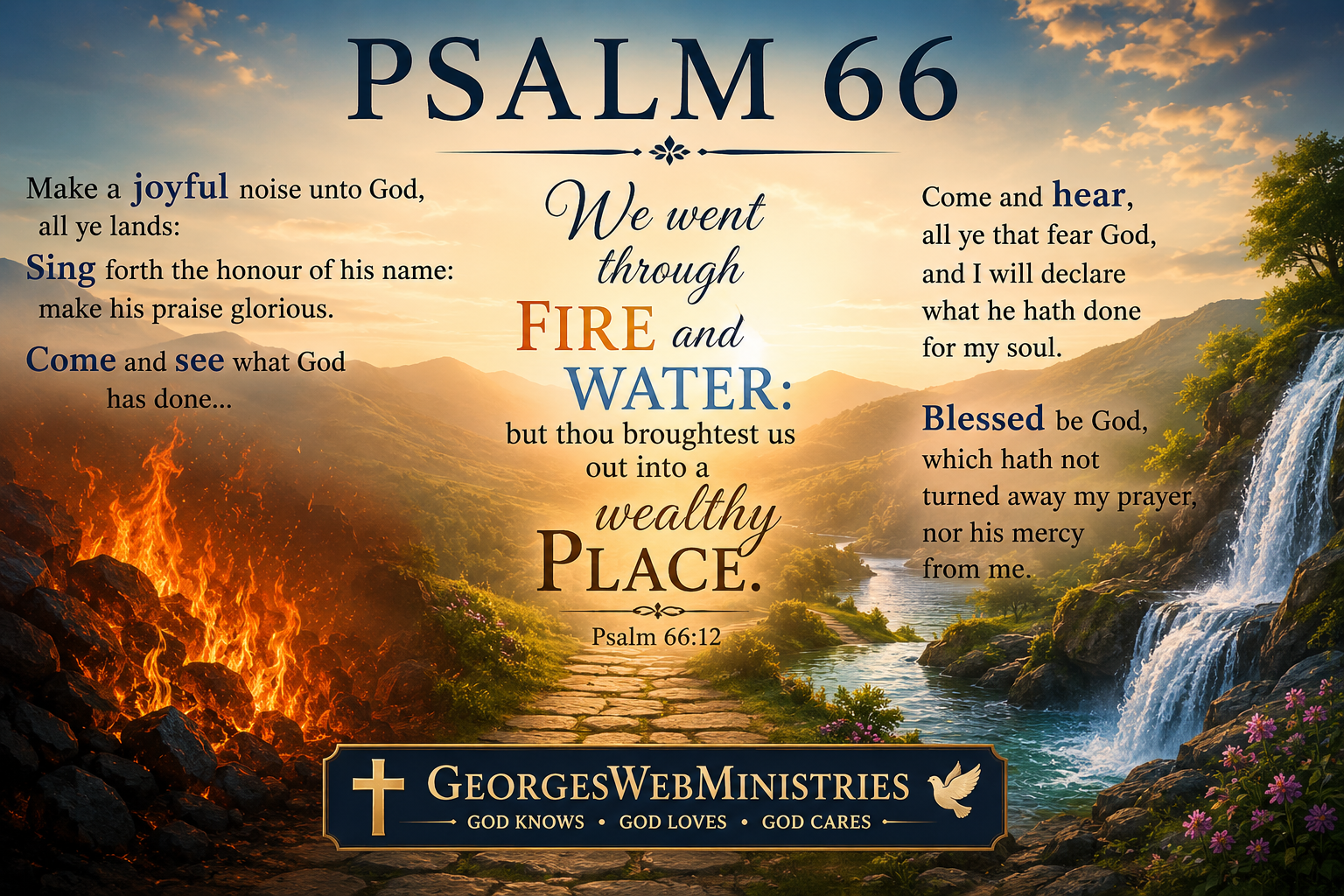

Psalm 66 is a song of praise, gratitude, and worship that celebrates God’s power, deliverance, and faithfulness. It moves from a call for all the earth to worship God to a very personal testimony of answered prayer.
Here’s a simple breakdown of the psalm:
Overview of Psalm 66
Theme
God deserves praise because:
- He rules with power
- He delivers His people through trials
- He listens to sincere prayer
The psalm combines:
- Corporate worship (everyone praising God)
- Personal testimony (one person sharing what God did)
Structure and Meaning
1. A Call for the Whole Earth to Praise God (Verses 1–4)
“Shout for joy to God, all the earth!”
The psalm begins with joyful worship. The writer invites all nations to:
- sing God’s glory,
- praise His name,
- recognize His awesome power.
Key idea:
God is not just Israel’s God—He is Lord over all creation.
These verses emphasise:
- God’s greatness
- universal worship
- joyful celebration
2. Remembering God’s Mighty Acts (Verses 5–7)
The psalm recalls how God acted in history, especially:
- crossing the Red Sea,
- leading Israel through danger,
- protecting His people.
“He turned the sea into dry land…”
Key idea:
Past deliverance builds present faith.
The writer says:
“Look what God has done before—He is trustworthy now.”
3. God Uses Trials to Refine His People (Verses 8–12)
This section becomes deeper and more personal.
The psalmist describes suffering:
- being tested,
- trapped,
- burdened,
- passing through “fire and water.”
Yet God brings them through it safely.
“We went through fire and water, but you brought us to a place of abundance.”
Key idea:
Trials are not proof God abandoned His people.
Instead, God can use hardship to:
- refine faith,
- strengthen character,
- lead to blessing.
This is one of the most quoted parts of Psalm 66 because it speaks to perseverance through suffering.
4. Personal Worship and Testimony (Verses 13–20)
Now the writer speaks personally:
- bringing sacrifices,
- fulfilling vows,
- telling others what God has done.
“Come and hear, all you who fear God; let me tell you what he has done for me.”
The psalmist explains:
- he cried out to God,
- God listened,
- prayer was answered.
But there’s also an important spiritual lesson:
“If I had cherished sin in my heart, the Lord would not have listened.”
Key idea:
Sincere prayer involves honesty and repentance.
The psalm ends with gratitude:
“Praise be to God, who has not rejected my prayer or withheld his love from me!”
Major Lessons from Psalm 66
1. Worship should be joyful
Praise is not merely duty—it is celebration.
2. Remember God’s faithfulness
Looking back at God’s past help strengthens faith for current struggles.
3. Trials can refine us
“Fire and water” symbolize intense testing, but God brings His people through.
4. Personal testimony matters
Sharing what God has done encourages others.
5. God hears sincere prayer
A humble, repentant heart matters in prayer.
Famous Verses
Some well-known lines from Psalm 66 include:
- “Shout for joy to God, all the earth!”
- “Come and see what God has done.”
- “We went through fire and water.”
- “Come and hear… let me tell you what he has done for me.”
In Simple Terms
Psalm 66 says:
“God is powerful, faithful, and worthy of praise.
Even when He allows hard seasons, He brings His people through them.
So worship Him, remember His works, and trust that He hears sincere prayer.”
GOD IS A GOOD GOD
GOD KNOWS, GOD LOVES, GOD CARES
Written for Georges web ministries
10th June 2026