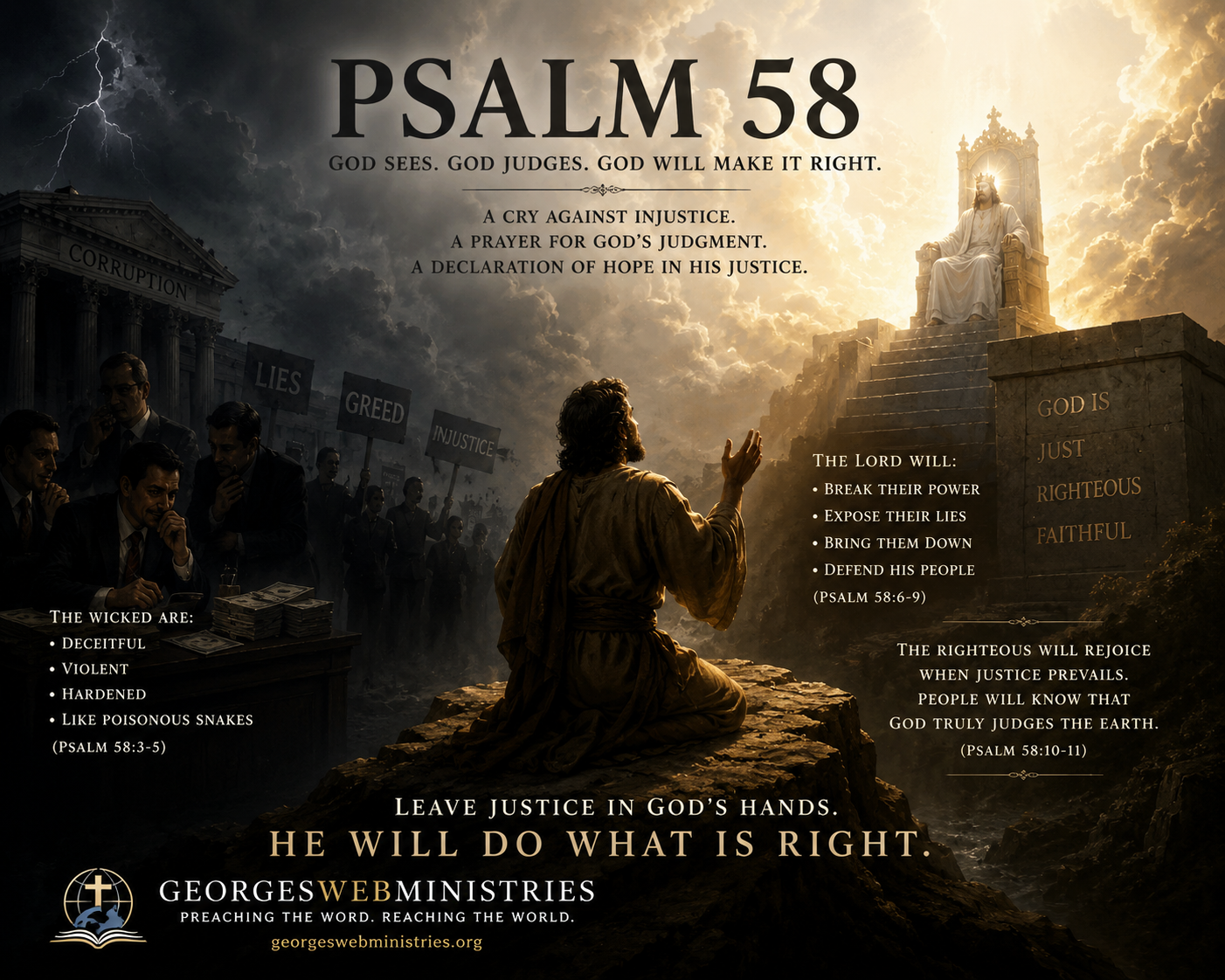

A Sermon on Psalm 58
“When Justice Seems Far Away”
Introduction
There are moments in life when we look around and ask,,
“Where is justice?”.
We see corruption rewarded, truth ignored, and innocent people suffering while the wicked seem to prosper. Many hearts today are burdened with disappointment in leaders, systems, and even people they once trusted. Psalm 58 speaks directly into that pain.
David wrote this psalm during a time of deep frustration. He saw rulers who should have defended truth instead spreading injustice. Yet instead of taking revenge himself, David brought his cries before God.
Psalm 58 reminds us that God still sees, God still knows, and God will still judge rightly.
1. God Sees Corrupt Hearts
David begins by asking:
“Do ye indeed speak righteousness, O congregation? do ye judge uprightly, O ye sons of men?”
The people entrusted with justice were failing in their duty. They spoke one thing publicly but practiced another privately.
How relevant this still is today.
There are times when people in authority fail the weak, ignore truth, or twist what is right. But Psalm 58 teaches us something important: even when earthly justice fails, Heaven’s justice never fails.
God is not blind to corruption.
God is not confused by deception.
Nothing escapes His sight.
Many people can fool society, but no one can fool Almighty God.
2. The Danger of a Hardened Heart
David describes the wicked like poisonous serpents that refuse to listen.
This speaks of hearts that have become hardened against truth.
Sin does something dangerous when it is continually embraced—it dulls the conscience. A person can reach a place where wrong no longer feels wrong.
That is why we must guard our hearts carefully.
A hardened heart does not happen overnight.
It happens little by little:
- ignoring conviction,
- excusing sin,
- resisting truth,
- refusing correction.
But the beautiful message of the Gospel is this:
Jesus Christ can soften even the hardest heart.
Where bitterness lives, He can bring mercy.
Where anger lives, He can bring peace.
Where darkness lives, He can bring light.
3. Leave Judgment in God’s Hands
The language in Psalm 58 is strong because David was deeply wounded by injustice. Yet notice something important:
David prayed to God instead of taking revenge himself.
That is a powerful lesson.
When hurt and anger rise within us, we are tempted to strike back, hold grudges, or become consumed by bitterness. But the Bible teaches us:
“Vengeance is mine; I will repay, saith the Lord.”
There is freedom when we place judgment into God’s hands.
God judges far more perfectly than we ever could.
He knows every motive.
Every hidden act.
Every lie.
Every wound.
And because God is righteous, His judgment is always perfect.
4. God Will Have the Final Word
Psalm 58 ends with confidence that righteousness will prevail.
Today evil may seem loud.
Truth may seem mocked.
Good people may feel weary.
But this world is not spinning out of God’s control.
There is still a throne in Heaven.
There is still a righteous Judge.
There is still hope for those who trust in Him.
One day every wrong will be answered.
Every hidden thing revealed.
Every tear understood.
For the believer, this is not merely a warning—it is comfort.
Because the same God who judges evil also saves those who call upon Him.
Conclusion
Psalm 58 teaches us:
- God sees injustice.
- God knows the truth.
- God judges righteously.
- And God calls us to trust Him rather than become consumed by bitterness.
In a world filled with confusion and broken systems, our hope is not in man alone—it is in the Lord.
And through Jesus Christ, we find mercy, forgiveness, and peace.
So today:
Do not let evil harden your heart.
Do not let bitterness consume your soul.
Bring your burdens to God.
For the Judge of all the earth shall do right.
Amen.
GOD IS A GOOD GOD
GOD KNOWS GOD LOVES GOD CARES
Written for georgeswebministries
31t st May 2026